

As seen on Mulberry Street
ANOTHER BORDER NYC
LITTLE ITALY / NOLITA
OCT-2025
Little Italy today is less a neighborhood and more a condensed memory, reduced to a few blocks around Mulberry Street. In the early 20th century, it was one of the largest Italian enclaves outside Italy, formed mainly by immigrants from southern regions — Sicily, Campania, Calabria. Dialects were spoken on the street, food was cheap, buildings were overcrowded, and identity was built collectively, often in opposition to the rest of the city.
After World War II, economic mobility, migration to Brooklyn, Queens, and New Jersey, and later real-estate pressure caused Little Italy to shrink. What remained became a touristic stage, filled with recognizable symbols: flags, string lights, “traditional” menus, façades preserved almost like theatrical scenery.
Surrounding it, NoLIta (North of Little Italy) emerged as its symbolic opposite: minimalist boutiques, quiet cafés, globalized aesthetics, self-referential consumption. Where Little Italy performs memory, NoLIta performs the present.
Photographing this area today means photographing the friction between what resists and what has already turned into an image of itself.

Those Who Looked First
Learning with those who have done it before us.

1955

1973

1974
1955
Pre Production
Weather
-
Overcast days: ideal for daytime scenes, portraits, and façades.
-
Dry nights: better contrast control and cleaner reflections.
-
Light rain: can work as a narrative bonus (reflections + isolation).
Location
Streets
-
Mulberry Street (between Canal St and Broome St)
-
Prince Street (transition into NoLIta)
-
Grand Street (less obvious edges)
-
Mott Street (a seam between the two worlds)
Subway
-
Grand St D/ B
-
Canal St. 4 / 6 (Lexington Ave) N / Q / R / W (Broadway) J / Z (Nassau St)
-
Prince St. W/ R
-
Spring St. 6

Best time to shoot
-
Early morning (7am–9am): Nice light comes trough Grand St. Local people.
-
Late afternoon (golden → blue hour): Symbolic transition.
-
Night (7pm–10pm): Reflections, neons, lights
Suggested Equipment
Kit A — Observational
-
35mm
-
Flexible ISO
-
Discreet camera
Kit B — Night / theatrical
-
28mm or 35mm
-
Fast lens (f/1.4 – f/2)
-
High ISO as language, not flaw
Kit C — Layers & reflections
-
50mm
-
Active search for glass, windows, overlays

Production
What to look for
01. Façades as scenery
02. Isolated people within excess
03. Partially erased old signage
04. Artificial light as protagonist
05. Reflections mixing inside and outside
06. Tourists in pause
07. Local workers
08. Kitsch objects as cultural symbols
09. Streets emptied after peak hours
10. Conflict between old typography and contemporary aesthetics

Canon R5 - lens: Voigtlander 35mm 2.0 f 5.6 • 1/45 • ISO 1250
Canon R5 - lens: 24/70mm Canon 2.8 f 2.8 • 1/90 • ISO 100

Canon R5 - lens: 35mm Canon 1.4 f 4.5 • 1/500 • ISO 200
Canon R5 - lens: Voigtlander 35mm 2.0 f 5.6 • 1/45 • ISO 1250

Post Production
Editing

Gradding


COLOR PRESETS
Publishing
Framing

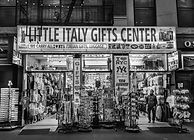
Italy and food have gone hand in hand since the beginning of time. I chose three images to illustrate how Little Italy was shaped as a place. Two are closely related, both from the Mulberry Street block where the traditional restaurants are concentrated; the third comes from a gift shop on the opposite wall, completing the picture of this space.


After Hours
Bars and Restaurants

New York’s oldest Italian bakery, since 1891. In Scorsese’s documentary, he meets his friends at this place for a conversation.

One of my favorites in town, the bar is an old neighborhood tavern originally opened illegaly in the 1920s.

The last butcher in Little Italy, est 1923. You won't eat over there, but it deserves the visit.
New York’s oldest Italian bakery, since 1891. In Scorsese’s documentary, he meets his friends at this place for a conversation.
